

What is the difference between a tension spring and a torsion spring?
Leave a message
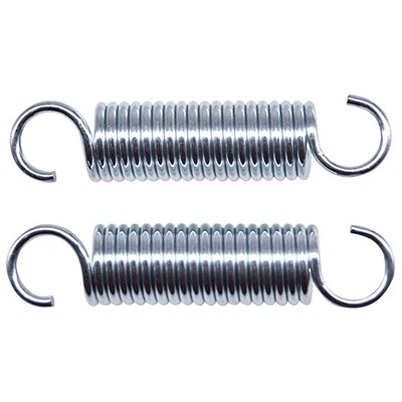
Extension springs (also known as tension springs, abbreviated as tension springs) are spiral springs that withstand axial tension. Extension springs are generally made of circular cross-section materials. When not under load, the coils of the tension spring are generally tight without any gap between them.
Each circle is tightly wrapped to allow it to be stretched by force, with a loop at each end.
The following is the necessary information for a tension spring:
(1) Free length: (a) total length, (b) total loop length, and (c) length within the hook loop.
(2) Control diameter: (a) outer diameter, (b) inner diameter, and (c) inner diameter of the casing.
(3) Wire size "wire diameter".
(4) Material (type, grade).
(5) Number of turns: (a) total number of turns and (b) right or left rotation.
(6) The form of the end.
(7) The load inside the hook.
(8) Load rate, deflection, pounds per inch.
(9) Maximum stretching length.
Torsion spring is a mechanical force storage structure mainly used in ancient crossbows and other crossbows. A torsion spring accumulates force by twisting or rotating elastic materials with soft and high toughness, utilizing them to give the projectile a certain amount of mechanical energy.
Torsion Spring is the ultimate variant of spring, which can be shaped according to design, from a single torsion spring to a double torsion spring, and even the deformation of various torsion bars.
Torsion Spring is one of the most complex design principles among all spring categories, and its variations in form are also quite lively. Therefore, the theory involved in design is also the most cumbersome. Therefore, it is also difficult to master during design
Necessary information for torsion springs:
(1) Free length.
(2) Control diameter: (a) outer diameter, (b) inner diameter, (c) inner diameter of the casing, or (d) outer diameter of the circular rod traversed.
(3) Wire size "wire diameter".
(4) Material (type and grade).
(5) Torsion force: The number of pounds deflected to a certain angle.
(6) Maximum deflection (angle from free position).
(7) The form of the end.
Please specify: material diameter (d), outer diameter (D), torsion arm length (L), free height (Lo), and other geometric dimensions, such as guide moment (T 1 T 2... T j) and corresponding and corresponding torsion angles( Ψ )